Copper vs. Aluminum Finned Tubes: Which Offers Better Long-Term Value?
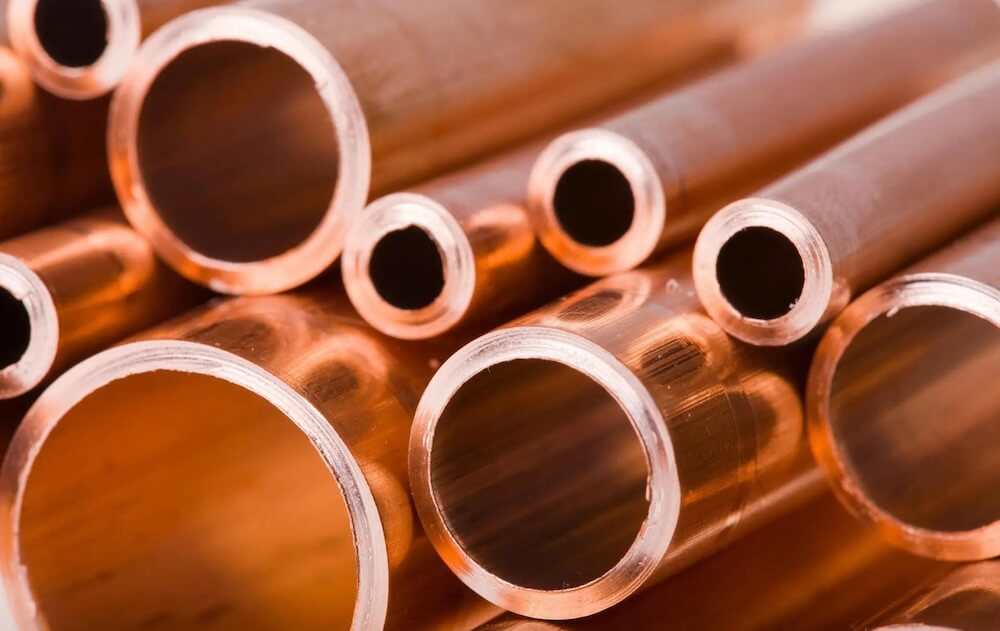
When selecting heat exchanger components, one of the most common questions engineers and equipment manufacturers face is whether to choose copper or aluminum finned tubes. Both materials are widely used in heat transfer applications, and each offers distinct advantages in terms of thermal performance, weight, corrosion behavior, manufacturing costs, and service life.
At first glance, aluminum may appear to be the more economical option, while copper is often associated with superior thermal conductivity and reliability. However, comparing these materials based solely on their initial purchase prices can lead to the wrong decision.
The real question is not simply which material costs less, but which one delivers better overall value throughout the operating life of the heat exchanger.
In this article, we will examine the differences between copper and aluminum finned tubes from a practical engineering and purchasing perspective, helping OEM manufacturers, engineers, and industrial buyers make more informed decisions.
- Thermal Conductivity: Copper Has a Clear Advantage
Thermal conductivity is one of the most important factors when evaluating materials for heat exchangers. It determines how efficiently heat can transfer through the material.
Copper has a thermal conductivity of approximately 390–400 W/(m·K), while aluminum typically ranges from 200–240 W/(m·K), depending on the alloy and temper.
This means copper can conduct heat significantly faster than aluminum.
For heat exchangers operating under demanding conditions, this difference can be important. Copper tubes can provide efficient heat transfer between the working fluid inside the tube and the surrounding fins, particularly when the tube-to-fin contact is properly designed and manufactured.
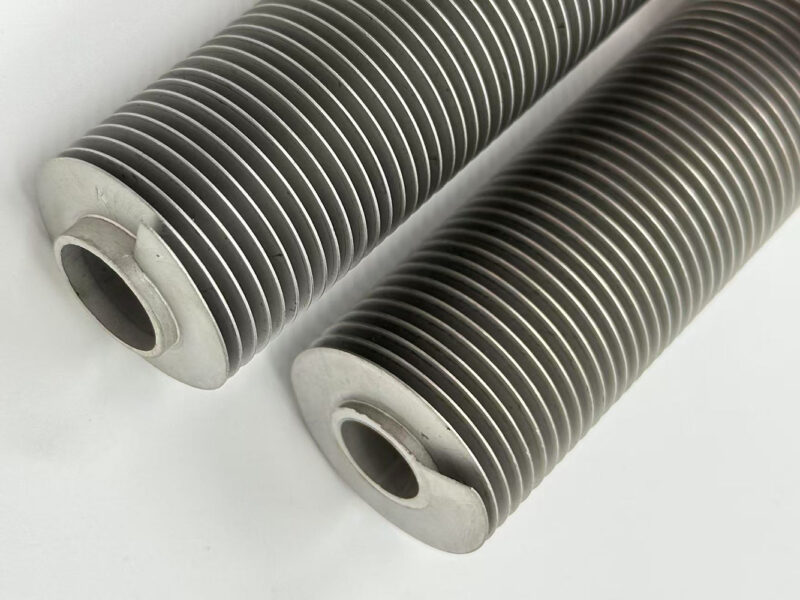
Aluminum, on the other hand, offers relatively good thermal conductivity while being much lighter. It is widely used in air-cooled heat exchangers, automotive radiators, and HVAC equipment where weight and manufacturing efficiency are important considerations.
However, thermal conductivity alone does not determine the overall efficiency of a heat exchanger. Other factors, including fin geometry, surface area, airflow, fluid velocity, tube arrangement, and contact resistance between tubes and fins, also play essential roles.
Our engineering perspective: A material with higher thermal conductivity does not automatically produce a more efficient heat exchanger. The entire heat transfer structure must be considered. Nevertheless, when thermal performance is a critical requirement, copper provides a valuable advantage that should not be overlooked.
- Corrosion Resistance: The Operating Environment Matters
Corrosion resistance is another major consideration, especially for industrial heat exchangers operating continuously under challenging environmental conditions.
Both copper and aluminum have their own corrosion characteristics.
Copper generally offers good corrosion resistance in many water-based and industrial applications. It performs reliably in properly designed systems and is widely used in condensers, evaporators, chillers, water heaters, and other heat transfer equipment.
However, copper is not immune to corrosion. Certain water chemistries, ammonia environments, sulfides, and aggressive chemicals can cause serious corrosion problems. Material compatibility must always be evaluated according to the actual operating conditions.
Aluminum naturally forms a thin oxide layer on its surface, which provides protection against further oxidation. This makes aluminum suitable for many air-conditioning and refrigeration applications.
However, aluminum can be vulnerable to pitting and localized corrosion in environments containing chlorides, as well as under certain acidic or alkaline conditions.
Another important consideration is galvanic corrosion.
When copper and aluminum are electrically connected in the presence of moisture or an electrolyte, galvanic corrosion may occur. This is particularly relevant in heat exchangers using copper tubes and aluminum fins.
Proper material selection, protective coatings, drainage design, and manufacturing quality are essential to reduce this risk.
Our engineering perspective: There is no universally corrosion-proof material. The correct choice depends on the cooling medium, operating temperature, humidity, chemical exposure, and maintenance conditions. Buyers should evaluate the complete operating environment rather than relying on general material descriptions.
- Weight and Mechanical Properties: Aluminum Offers Greater Flexibility
One of aluminum’s strongest advantages is its low density.
Aluminum has a density of approximately 2.7 g/cm³, compared with copper at approximately 8.96 g/cm³.
In other words, copper is more than three times as dense as aluminum.
For applications where equipment weight is a major concern, aluminum can offer significant benefits. This is particularly relevant to automotive cooling systems, transportation equipment, compact air-conditioning units, and applications where reducing structural loads is important.
Copper, however, offers different mechanical advantages.
It generally provides good ductility, making it suitable for tube expansion, bending, forming, and various heat exchanger manufacturing processes. Its mechanical characteristics also make it attractive for applications requiring reliable tube connections and robust construction.
Of course, the actual mechanical performance depends on the selected alloy, wall thickness, temper, manufacturing method, and operating pressure.
For high-pressure applications, engineers must consider the tube’s design pressure, allowable stress, wall thickness, and relevant design standards rather than simply comparing copper and aluminum as raw materials.
Our engineering perspective: Lightweight construction is valuable, but it should not come at the expense of structural reliability. For stationary industrial equipment, the weight advantage of aluminum may be less important than pressure capability, mechanical stability, and long-term operating performance.
- Manufacturing and Maintenance: Initial Cost Is Only Part of the Story
From a purchasing perspective, aluminum is often attractive because of its relatively low material cost and suitability for high-volume manufacturing.
Aluminum heat exchangers can be manufactured using efficient brazing and forming processes, making them particularly competitive in mass-produced HVAC and automotive applications.
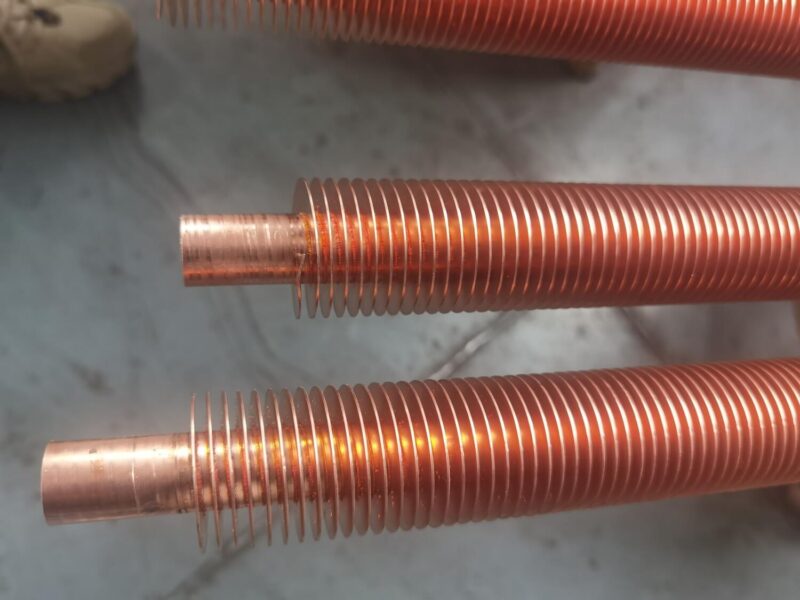
Copper finned tubes, meanwhile, offer excellent versatility in terms of tube dimensions, fin configurations, and customized heat exchanger designs.
Depending on the product type, manufacturing methods may include:
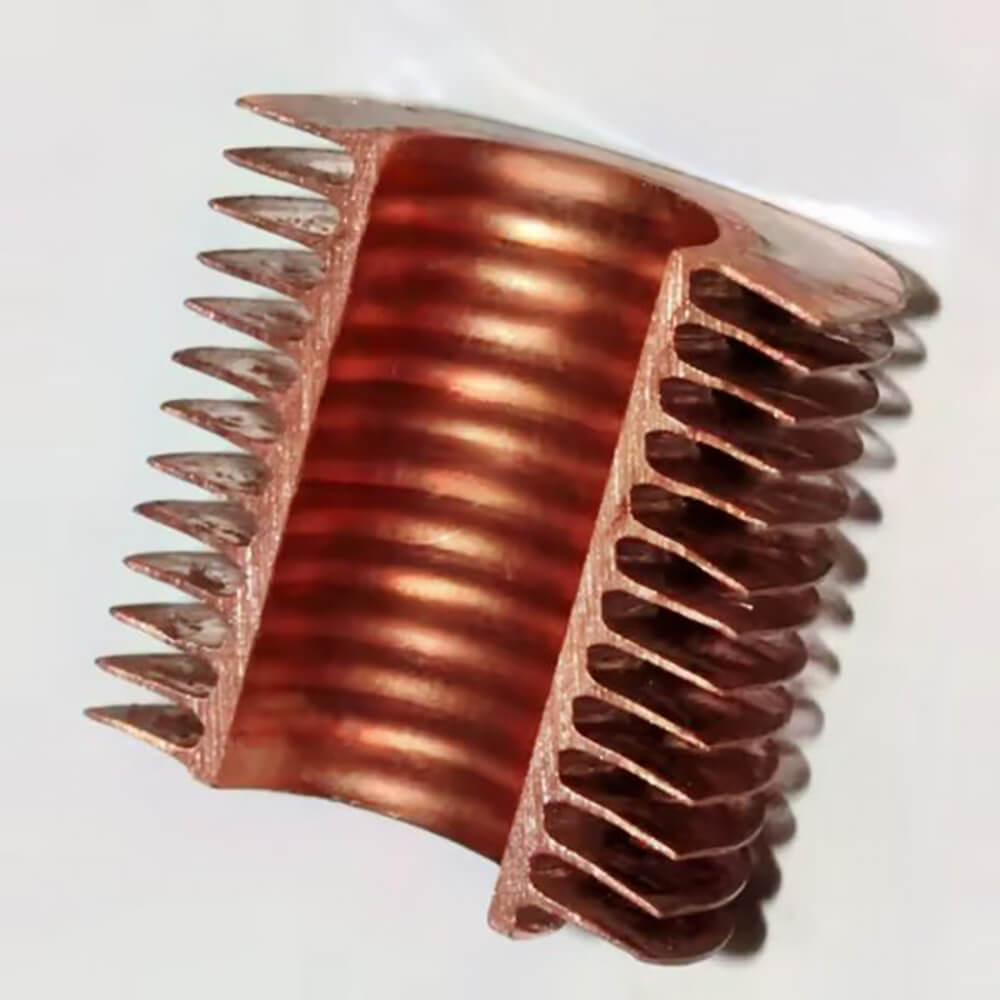
- Integral finning, where fins are formed directly from the tube wall.
- Extruded finning, commonly used for specialized heat transfer requirements.
- Embedded or tension-wound finning, where fins are mechanically attached to the base tube.
- Other customized fin configurations designed for specific operating conditions.
The choice of manufacturing process affects fin-to-tube contact, mechanical integrity, heat transfer performance, and long-term reliability.
Maintenance is another factor that deserves attention.
A heat exchanger that requires frequent cleaning, repair, or replacement may generate substantial costs over time. The actual maintenance burden depends on operating conditions, fluid quality, environmental exposure, accessibility, and equipment design.
Copper tubes can be particularly attractive in industrial applications where long-term reliability and serviceability are important. However, properly designed aluminum heat exchangers can also deliver excellent service life in suitable environments.
Our engineering perspective: Purchasing managers should look beyond the supplier’s unit price. A slightly higher initial investment may be justified if it reduces maintenance requirements, unplanned downtime, and replacement costs.
- Copper vs. Aluminum: A Practical Comparison
The following table summarizes the major differences between these two materials.
| Comparison | Copper | Aluminum |
| Thermal conductivity | Higher | Lower |
| Density | Higher | Much lower |
| Weight | Heavier | Lighter |
| Corrosion behavior | Good in many suitable environments | Good in suitable environments |
| Mechanical characteristics | Good ductility and formability | Lightweight and formable |
| Manufacturing | Versatile tube processing | Efficient mass production |
| Initial material cost | Generally higher | Generally lower |
| Typical applications | Industrial heat exchangers, condensers, chillers | Automotive radiators, HVAC units, compact heat exchangers |
One important point: these comparisons refer to the base material characteristics. Actual heat exchanger performance also depends on alloy selection, tube dimensions, fin design, joining methods, and manufacturing quality.
- Which Material Is Better for Different Applications?
Rather than choosing one material for every application, engineers should match the material to the specific operating requirements.
Copper finned tubes are worth considering for:
- Industrial condensers and evaporators.
- Chillers and refrigeration equipment.
- Water heaters and heat pump systems.
- Shell-and-tube heat exchangers.
- Industrial cooling coils.
- Applications requiring customized tube dimensions and fin configurations.
Aluminum heat exchangers are often suitable for:
- Automotive radiators.
- Mass-produced air-conditioning equipment.
- Lightweight cooling systems.
- Applications where compact design and low equipment weight are priorities.
- High-volume products where manufacturing cost is a major consideration.
For particularly aggressive environments, neither copper nor aluminum should be selected automatically. Stainless steel, titanium, cupronickel, or other specialized materials may be more appropriate, depending on the application.
The most important step is to understand the operating conditions before finalizing the material specification.
- The Real Measure of Value: Total Cost of Ownership
This is where we believe many purchasing decisions need a different perspective.
In international sourcing, buyers often compare suppliers by looking at the price per meter, price per kilogram, or total purchase value. These figures are useful, but they do not tell the complete story.
Consider two heat exchanger designs:
One uses a lower-cost material but requires more frequent maintenance or has a shorter service life under actual operating conditions.
The other has a higher initial material cost but provides more reliable operation, better suitability for the application, and fewer unexpected maintenance requirements.
Which one is more economical?
The answer should be based on total cost of ownership (TCO), not simply the initial quotation.
A practical evaluation should include:
- Initial material and manufacturing costs.
- Heat transfer performance and energy consumption.
- Expected operating life.
- Inspection and maintenance expenses.
- Replacement costs and equipment downtime.
- Compatibility with the working fluid and operating environment.
For industrial customers, particularly those supplying mining, power generation, oil and gas, and other demanding industries, unexpected equipment downtime can be considerably more expensive than the original material price difference.
This is why material selection should be treated as an engineering decision as much as a purchasing decision.
- Cufintube’s Perspective: Choose the Right Material, Not Just the Cheaper One
At Cufintube, we believe that the best heat exchanger material is not necessarily the most expensive or the least expensive one. It is the material that performs consistently under the actual operating conditions of the equipment.
Copper finned tubes remain an important choice for many industrial heat transfer applications because of their excellent thermal conductivity, manufacturing versatility, and suitability for a wide range of customized designs.
However, we also recognize that aluminum and other materials have their own advantages. Recommending copper for every application would not be a responsible engineering approach.
Our priority is to understand what customers really need: operating temperature, working pressure, heat transfer requirements, working medium, environmental conditions, tube dimensions, and expected service life.
With manufacturing experience dating back to 1984, Cufintube provides a wide range of finned tube solutions for heat exchangers, including copper, cupronickel, stainless steel, titanium, and customized finned tube products.
We believe a good supplier should do more than manufacture products according to drawings. A reliable supplier should also understand the application, pay attention to manufacturing consistency, and help customers make technically and commercially sensible decisions.
Because in the heat exchanger industry, the cheapest component is not always the most economical one. The right component is the one that keeps your equipment performing reliably, year after year.
Looking for a reliable finned tube manufacturer in China? Contact Cufintube to discuss your project requirements and customized heat transfer solutions.